 +91-9373821410
  info@indilok.com
Physical Vapor Deposition (PVD) is a vital technology for the modern manufacturing world, enabling the creation of hard, functional, decorative, and protective coatings across industries ranging from aerospace and automotive to electronics and medical devices. PVD is a category of vacuum deposition processes in which materials are physically vaporized from a solid source and then deposited onto a substrate to form a thin film or coating.
At Girase Technologies, we support precision-driven processes like PVD with our range of Ultra-High Purity (UHP) fittings, vacuum components, and system design expertise, ensuring the success of even the most demanding thin-film applications.
What is Physical Vapor Deposition?
Physical Vapor Deposition refers to a group of technologies used to deposit very thin layers of material — typically in the range of a few nanometers to several micrometers — onto a target surface. Unlike chemical deposition methods, PVD involves no chemical reaction at the surface; instead, it relies purely on physical processes such as evaporation, sublimation, and condensation.
The PVD process generally occurs in a high-vacuum chamber (typically between 10⁻³ to 10⁻⁶ Torr) to minimize contamination and ensure film purity.
How Does PVD Work?
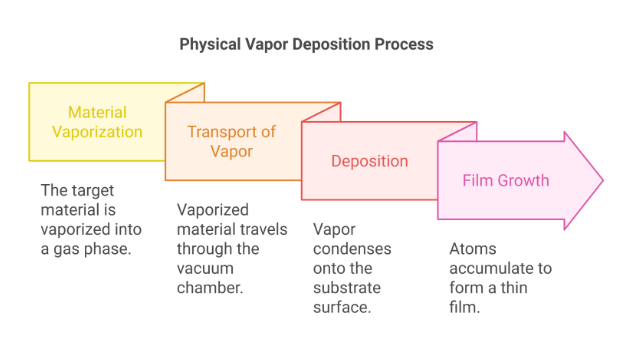
The basic PVD process can be broken down into four main steps:
- Material Vaporization
A solid source material (known as the target) is heated or bombarded with energy (thermal, electron beam, or ion bombardment) until it vaporizes into a gas phase. - Transport of Vapor
The vaporized material atoms or molecules travel through the vacuum chamber towards the substrate. - Deposition
The vapor condenses onto the substrate surface, forming a thin solid film. - Film Growth
Over time, atoms accumulate, layer by layer, creating the final coating with specific thickness and properties.
The entire process is physical in nature — no chemical transformation of the source material occurs during transport or deposition.
Types of PVD Techniques
PVD encompasses several different technologies, each suited for specific materials, coating properties, and applications. The most common types are:
1. Evaporation
- In evaporation PVD, the target material is heated (by resistance heating, electron beam, or laser beam) until it vaporizes.
- Vapor atoms then condense directly onto the substrate.
- Evaporation provides high-purity coatings but can have line-of-sight limitations.
2. Sputtering
- In sputtering, ions (usually Argon ions) are accelerated toward the target material, physically knocking atoms off the surface through momentum transfer.
- These ejected atoms then deposit onto the substrate.
- Sputtering offers better adhesion, denser films, and the ability to coat complex 3D geometries.
3. Arc Vapor Deposition
- A high-current, low-voltage arc is struck on the target surface, vaporizing the material into a highly ionized plasma.
- The energetic ions improve film density and adhesion, making this technique ideal for hard coatings (e.g., TiN, CrN).
4. Pulsed Laser Deposition (PLD)
- A high-energy laser pulse ablates material from a target surface, creating a plasma plume that deposits onto the substrate.
- PLD is used for highly specialized thin films, including complex oxides and superconductors.
Key Process Conditions
To achieve high-quality, reproducible films, the following conditions must be carefully controlled during PVD:
| Parameter | Typical Value |
| Vacuum Level | 10⁻³ to 10⁻⁶ Torr |
| Deposition Rate | 0.1–10 µm/hour |
| Substrate Temperature | Ambient to 800°C (depending on material) |
| Target-Substrate Distance | 5–50 cm |
| Gas Types (for sputtering) | Argon, Nitrogen, Oxygen |
Applications of PVD Coatings
PVD coatings are used in a wide range of industries and applications, including:
- Semiconductors: Metallization layers for ICs and MEMS.
- Cutting Tools: Hard coatings like TiN, TiAlN for increased wear resistance.
- Medical Implants: Biocompatible coatings such as TiN or DLC (diamond-like carbon).
- Decorative Finishes: Gold-like finishes on watches, jewelry, and automotive trims.
- Optical Devices: Anti-reflection coatings, beam splitters, and filters.
Advantages of PVD
Physical Vapor Deposition offers several major benefits over other coating methods:
- High Purity Films: Minimal contamination from chemicals.
- Excellent Adhesion: Especially with proper surface preparation.
- Dense and Hard Coatings: Ideal for wear resistance and protection.
- Environmentally Friendly: Little to no toxic chemical waste.
- Fine Control Over Thickness: From a few nanometers to several micrometers.
- Multi-Layer and Complex Coatings: Easy to engineer layered materials.
Limitations of PVD
Despite its advantages, PVD also has some limitations to consider:
- Line-of-Sight Deposition: Particularly in evaporation methods, making it hard to coat hidden surfaces.
- High Capital Cost: Vacuum systems and targets can be expensive.
- Substrate Heating: High substrate temperatures may damage heat-sensitive materials.
- Limited Large-Area Uniformity: Challenging for very large substrates without advanced equipment.
Future Trends in PVD Technology
The field of PVD is evolving rapidly, driven by the needs of nanoelectronics, wearable technologies, and energy-efficient devices. Some exciting directions include:
- High-Power Impulse Magnetron Sputtering (HiPIMS): Produces highly ionized plasmas for even denser, harder films.
- Multi-Functional Coatings: Combining hardness, corrosion resistance, and electrical conductivity.
- Advanced In-Situ Monitoring: Real-time control over thickness, composition, and film structure.
- Green Coating Technologies: Focus on reducing energy consumption and eliminating hazardous materials.
Conclusion
Physical Vapor Deposition is a cornerstone of modern thin-film technology, offering unmatched purity, flexibility, and performance across a range of industries. Whether it’s coating the cutting edge of a surgical blade, protecting a microchip, or creating the brilliant finish on a luxury watch, PVD makes it possible.