 +91-9373821410
  info@indilok.com
Atomic Layer Deposition (ALD) is one of the most advanced and precise thin-film deposition technologies used today. Its ability to deposit materials one atomic layer at a time has made it a key process in semiconductor fabrication, photovoltaic devices, advanced optics, MEMS systems, and beyond. Among all the materials that can be deposited by ALD, Aluminum Oxide (Al₂O₃) stands out as one of the most widely used due to its excellent insulating, barrier, and passivation properties.
What is ALD and Why is it Unique?
Atomic Layer Deposition is a subclass of Chemical Vapor Deposition (CVD), but it offers significantly better control over film thickness, conformality, and uniformity. The key principle that sets ALD apart is its use of self-limiting surface reactions. Unlike conventional CVD, which continuously deposits material until the precursor is exhausted, ALD only deposits one atomic layer per cycle. This is achieved through alternating exposures of the substrate to different chemical precursors, with inert gas purges in between.
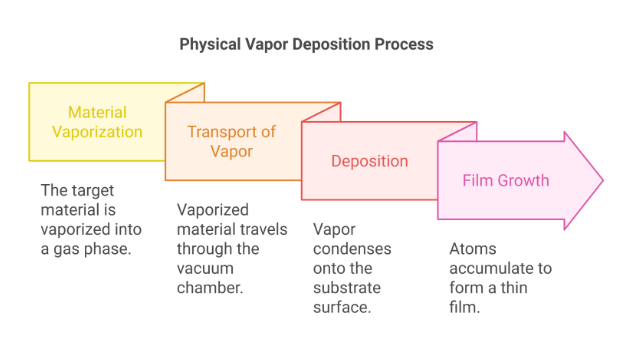
A standard ALD process involves four steps per cycle:
- Precursor A exposure – chemisorbs onto reactive sites on the substrate.
- Purge – removes excess precursor and byproducts.
- Precursor B exposure – reacts with the surface-bound species from step 1.
- Final purge – clears the chamber for the next cycle.
This repeatable process enables atomic-level precision, making ALD ideal for applications where nanoscale film integrity and uniformity are mission-critical.
ALD: The Chemistry
The most common ALD chemistry for depositing aluminum oxide involves the use of:
Trimethylaluminum (TMA) as the aluminum source Water (H₂O) or ozone (O₃) as the oxidant Reaction Mechanism:
TMA pulse:
AlOH* + Al(CH₃)₃ → Al-O-Al(CH₃)₂* + CH₄↑
Water pulse:
Al-CH₃* + H₂O → Al-OH* + CH₄↑
Overall Reaction:
2Al(CH3)3+3H2O→Al2O3+6CH4
Each step is self-limiting, meaning once all reactive sites are occupied, no further reaction occurs until the next precursor is introduced. This results in high-quality, pinhole-free, and conformal Al₂O₃ films, even over substrates with extreme topography or high aspect ratios.
Growth Characteristics and Control
The growth per cycle (GPC) for Al₂O₃ ALD using TMA and H₂O typically ranges from 1.0 to 1.2 angstroms per cycle, depending on temperature, surface conditions, and reactor configuration. Film thickness can be tuned precisely by adjusting the number of ALD cycles.
The process temperature range is typically 150–300°C, which is low enough to enable deposition on thermally sensitive materials like polymers. For even lower-temperature requirements, plasma-enhanced ALD (PEALD) is used, where plasma activates the surface to promote precursor reaction.
Substrate Dependence and Nucleation
The success and uniformity of Al₂O₃ growth heavily depend on the substrate’s surface chemistry. On SiO₂ surfaces, Al₂O₃ growth begins immediately due to the abundance of hydroxyl (-OH) groups that readily react with TMA.
On H-terminated silicon (Si-H), however, there is an incubation delay. This is because TMA does not react with hydrogen-terminated surfaces until they are oxidized or hydroxylated. Therefore, in semiconductor processing, a pre-treatment step or nucleation layer is often employed to ensure consistent growth from the first cycle onward.
Applications Across Industries
1. Semiconductor Manufacturing
ALD is used as a gate dielectric, spacer, or etch stop layer in advanced nodes. Its high-k properties make it a suitable replacement for SiO₂ in scaled devices.
2. Solar Cells
In PERC (Passivated Emitter and Rear Cell) solar technology, ALD puts a rear-side passivation layer, reducing surface recombination and increasing efficiency. Effective surface recombination velocities as low as 2.9 cm/s have been achieved.
3. Energy Storage
In lithium-ion and solid-state batteries, ALD provides conformal coatings on electrode particles such as LiCoO₂ or LiNiMnCoO₂. In solid-state batteries, ALD is used to deposit solid electrolytes and to engineer interfaces between electrodes and electrolytes, where interfacial resistance often limits performance.
4. Display Technologies
OLEDs, in particular, are sensitive to moisture and oxygen, and ALD-deposited Al₂O₃ or ZnO films provide superior encapsulation, extending device lifetimes significantly. These barriers are so thin and uniform that they are used in flexible displays, where mechanical durability and gas impermeability must coexist without adding bulk.
5. MEMS and NEMS Devices
In MEMS and sensor applications, ALD provides dielectric insulation, protects delicate structures, and prevents stiction. It tailors surface energy and adds passivation layers. This enhances mechanical reliability and performance in automotive, biomedical, and environmental sensors.
6. Biomedical Devices
In biomedicine, ALD coats implants, biosensors, and microfluidic devices with biocompatible, corrosion-resistant films. These coatings reduce immune response and bacterial adhesion. ALD is also used to control drug release by precisely adjusting film thickness.
Innovations in ALD: Spatial ALD for High Throughput
While traditional ALD is a time-sequenced process, recent innovations have introduced spatial ALD, where the precursors are kept separate in space instead of time. The substrate moves between gas zones, enabling continuous, high-throughput deposition.
(“Florian Werner” during his research on “High rate ALD for Al2O3 for the surface passivation” found that) Inline spatial ALD systems have demonstrated deposition rates of 30 nm/min, compared to conventional rates of 1–2 Å/cycle. These systems operate at atmospheric pressure and are increasingly adopted in mass production environments, especially in solar manufacturing.
The Future of ALD
As devices continue to scale down and materials become more integrated, ALD will remain a foundation of nanoscale fabrication. Future developments are expected to include:
New precursor chemistries with lower environmental impact
In-situ monitoring using techniques like quartz crystal microbalance (QCM) and ellipsometry
Hybrid ALD-CVD processes for better performance-to-throughput ratios
Integration of ALD in flexible electronics, photonic devices, and solid-state batteries
Al₂O₃, with its proven stability, conformality, and versatility, will continue to play a critical role in shaping these innovations.
Conclusion
Atomic Layer Deposition of Al₂O₃ exemplifies the future of material processing: precise, repeatable, and scalable. It combines the elegance of surface chemistry with the demands of modern industry, resulting in coatings that are both functional and reliable. Whether used in chip fabrication, energy devices, or medical equipment, Al₂O₃ films consistently outperform alternative coatings in terms of quality and reliability.